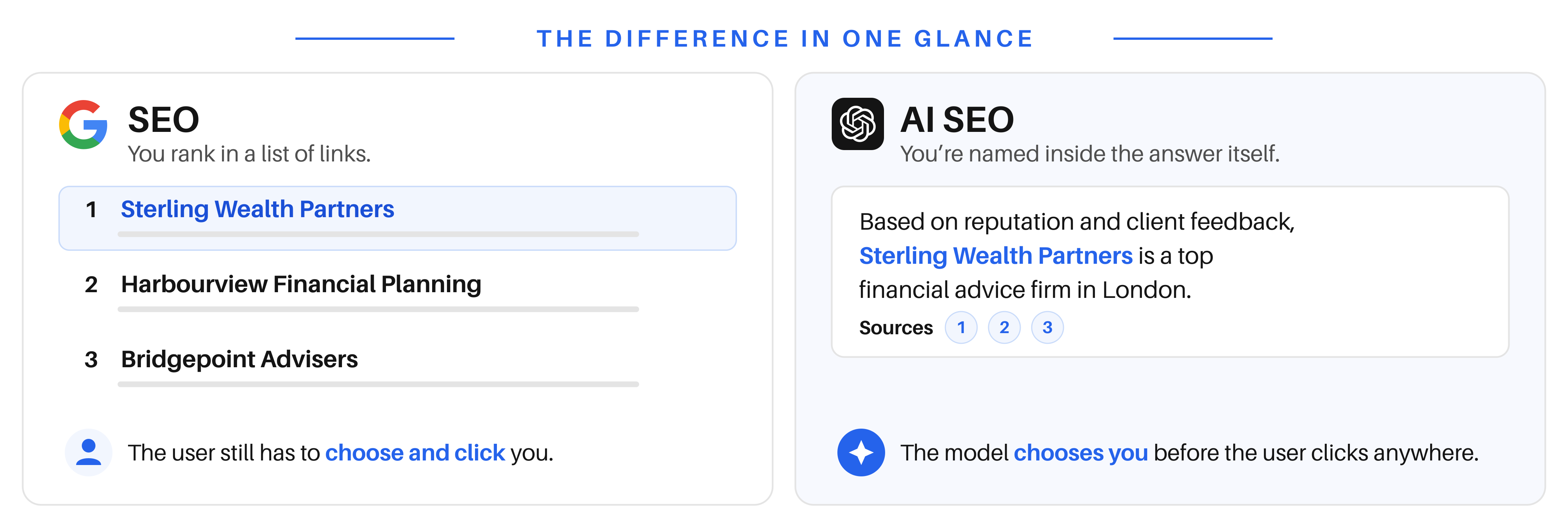
58% of consumers have already replaced traditional search engines with AI when deciding what to buy and who to use (Capgemini). That number is expected to grow to 75% by 2027. Your prospective clients are more than likely one of them- asking ChatGPT who they should choose instead of scrolling through a list of links on Google.
The industry calls getting into those answers GEO, AEO, AI SEO or AI search visibility- These are all essentially the same thing. Ignore the jargon.
Try it yourself → open ChatGPT and ask "who's the best [what you do] in [where you're based]?"
If your name comes up- that's a major advantage- If it doesn't, that's fixable- and simpler than you might think…
What happens when you ask AI to recommend?
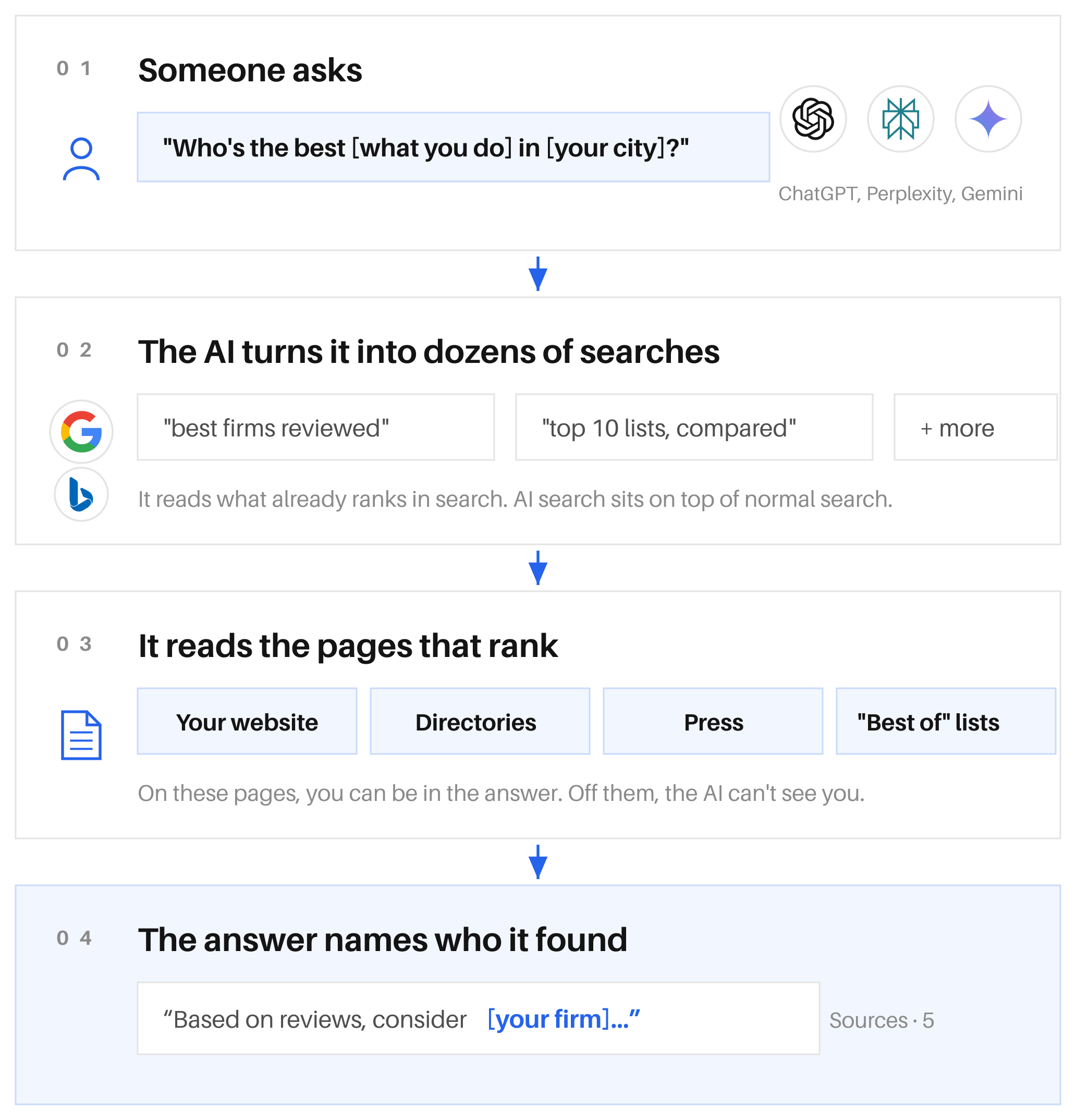
Say a business owner types this into ChatGPT "Who's the best financial adviser for business owners in London?"
The AI runs a selection of searches on your behalf- then reviews the content, rankings, directories, press, reviews, "best of" lists that come up. It then decides which is best to select, cite and name in the answer.
6 x key points that factor into that decision:
Relevance. What makes the biggest difference is focusing on providing value to a customer or client. Providing useful resources that answer key questions they want answered is the No1 differentiator here.
Evidence and Authority. Google calls this E-E-A-T (experience, expertise, authority, trust). Named authors with real credentials, an about page with real people, qualifications and dates on the page. Claims should be supported by real evidence and named sources.
Consistency. Is your name, expertise & offering described consistently across the web? If your services match everywhere, you're easy to recommend. If they clash, it won't be able to trust sources.
Accessibility. Can search engines find, crawl, index and clearly understand the relevant page?
Sources. Perplexity and Google's AI answers draw almost entirely from what ranks on Google, ChatGPT also searches through Bing and references Yell- they also pull heavily from Reddit and LinkedIn too.
Corroboration. AI favours names it can verify in more than one place. Credible external sources should confirm what your website says about you. Backlinks & third-party mentions help too.
Why AI Search is so effective: prospects come in pre-qualified
A visitor from Google clicked a link. A visitor from an AI answer had a conversation first- they asked about fees, fit, alternatives and their specific circumstances, and the AI recommended you by name.
That is a referral, not blind traffic. By the time they land on your site they're most of the way to a 'yes'.
A normal website converts 1-2% of visitors. Businesses tracking AI-referred visitors report 4-5 times that.
And barely anyone is doing this yet. In finance, the average Firm gets cited in less than 2.1% of AI answers (Boring Marketing).
When we tested 50 buyer questions about the UK financial adviser market across Chat GPT, Perplexity & Google- producing 450 AI answers- 93 of the UK's top 150 financial advice firms were totally invisible in AI search. Those that are getting this right hold a lot more power than the rest, regardless of their credentials.
How to get named
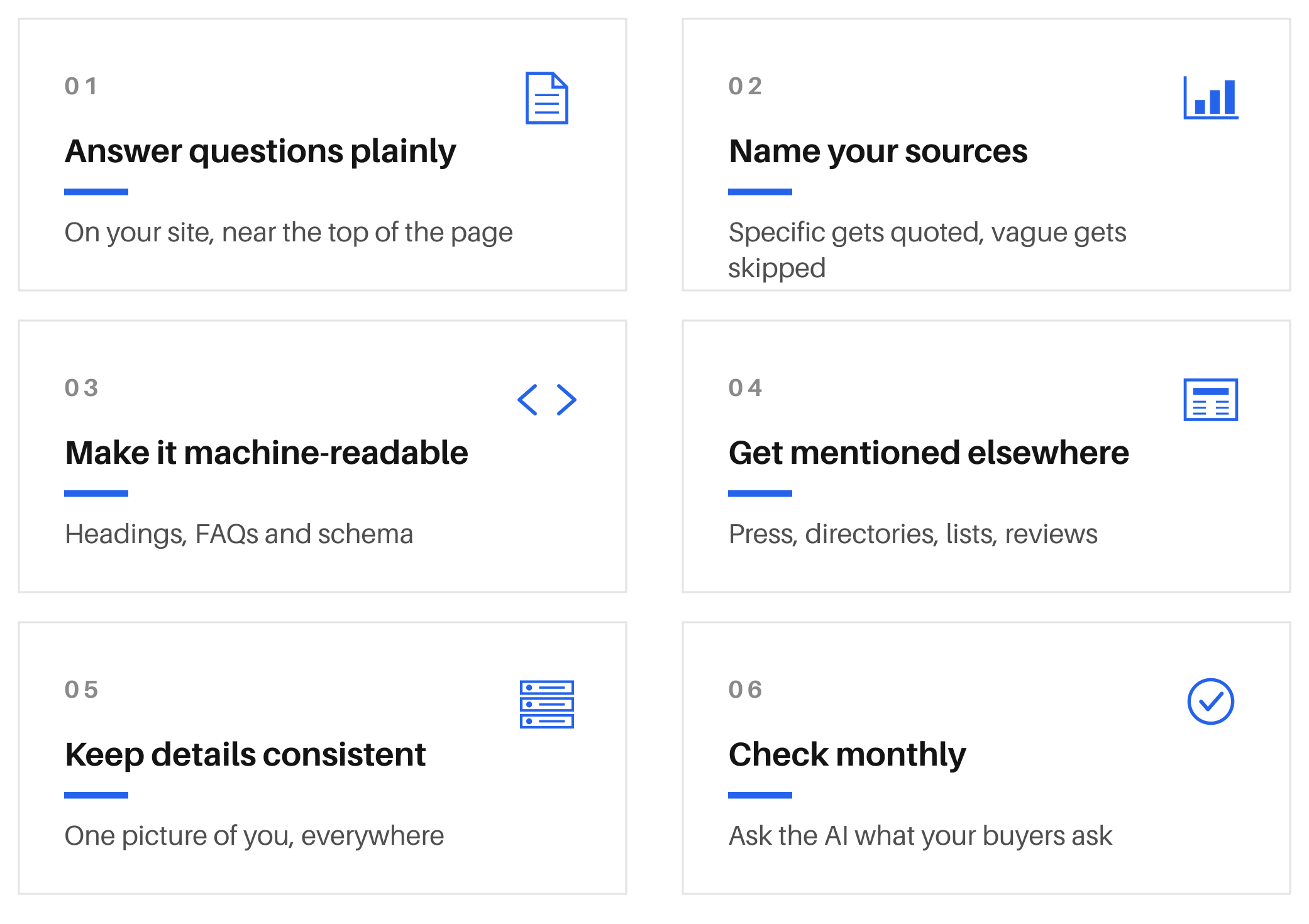
Answer real questions on your site → plainly, near the top of the page. AI quotes clean, self-contained answers. Buried points never get read.
Be specific and name your sources → "Many firms see results" gets skipped. A named figure from a named source gets quoted.
Make it readable by machines → clear headings, descriptive URLs and internal links. Add pages to your sitemap, use Google Search Console to index them. Add FAQs, schema and breadcrumbs to make it findable and readable- these are labels that tell AI what each part of your site is- ask Claude or Codex to add them for you.
Get mentioned in places you don't own → backlinks and third-party mentions are important- press, directories, roundups, reviews, Reddit and independent lists all corroborate what your own pages say. Ahrefs studied 75,000 brands and found mentions track AI visibility 3x more closely than backlinks.
Keep your details consistent everywhere → same name, same description, same services across your site, LinkedIn, your Google Business Profile and every listing. For local searches the AI leans heavily on your Google Business Profile and its reviews- keep both current.
Check monthly → test the same buyer questions each month across ChatGPT, Gemini and Perplexity in incognito mode. Record whether you are named, cited or absent, which pages are used, and the date. Use Search Console to monitor Google visibility and indexing.
How to start:
Write down ten questions prospective clients ask before choosing someone like you. Go to Perplexity and ask "who's the best [what you do] in [your city]?" (free at perplexity.ai)- under each answer it lists the related questions real people ask.
Test them across ChatGPT, Gemini and Perplexity and record the current answers.
Choose the most commercially important gap.
Improve or create one genuinely useful page that answers it with specific evidence.
Link to it internally, submit it through your sitemap and check indexing in Search Console.
Earn credible third-party evidence through relevant press, directories, reviews, expert contributions or independent mentions.
Run the same test again next month.
You can check out the more in depth version on Studiobaggio.ai guide to Generative Engine Optimisation for Professional Services.